

I’ve watched capable women spend months circling decisions they already know the answer to.
A role they’ve outgrown.
A project that’s complete.
A direction that keeps calling for their attention.
Because they’re still looking for certainty.
I recently came across the work of Nobel Prize-winning economist Herbert Simon, who studied how people make decisions.
He observed that most of us fall into one of two camps.
Maximizers search for the best possible choice.
Satisficers (Satisfy+Suffice) look for an option that is good enough.
At first glance, maximizing sounds wise.
But research suggests maximizers tend to be less satisfied with their decisions, more prone to regret, and more likely to keep comparing what they chose against what they didn’t.
On the other hand, Satisficers make a choice and move on.
This feels especially relevant right now.
Never before have we had so much information available to us. And now AI can help us gather even more.
Research faster.
Compare more options.
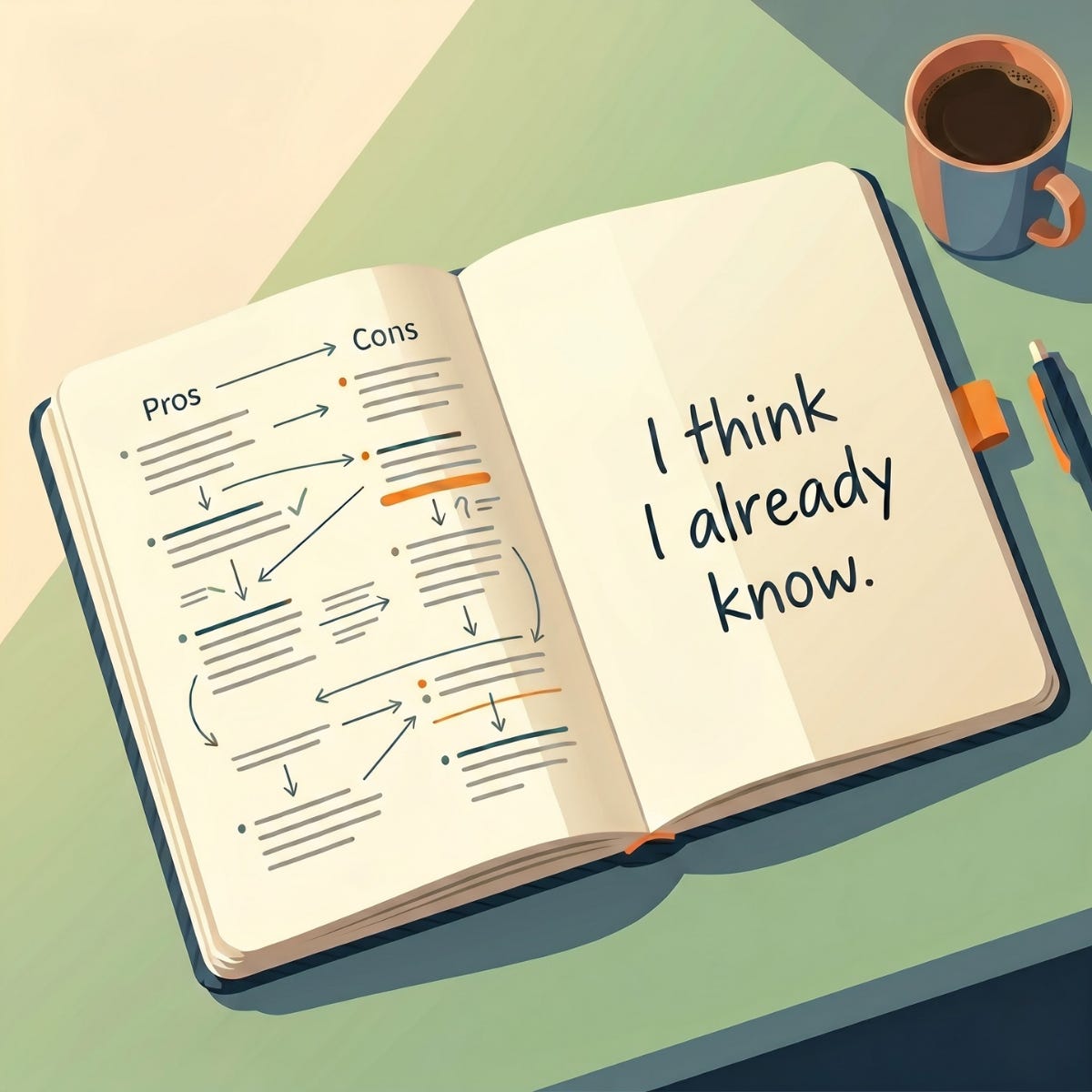
Generate endless pros and cons.
What begins as discernment can quietly become certainty-seeking.
And certainty-seeking has a way of keeping us standing still long after we know enough to move.
This isn’t an argument against gathering information. Sometimes you genuinely need more data.
The challenge is recognizing when you’re no longer searching for answers.
You’re searching for permission to trust yourself.
The leaders I admire most aren’t the ones who always know.
They’re the ones who learn to move before certainty arrives.
The Decision I Couldn’t Explain
In my last year at Stanford, I stepped away from a leadership role and returned to being an individual contributor.
My mind had plenty to say about it.
Why would you voluntarily step away from something you’ve worked so hard to build?
Why make what looked like a lateral move when everyone around you was trying to move up?
I couldn’t answer those questions.
I simply knew the role was complete.
And even though I couldn’t see where it was leading, I could feel it was time.
That’s often how clarity arrives.
Just enough truth for the next step.
This is the tricky part.
Knowing whether you’re genuinely not ready...or whether you’re already clear and simply afraid to trust yourself.
Inside this week’s Ritual, I’ll share the practice I use to distinguish discernment from delay—and the questions I return to when I’m trying to recognize the difference.